
Why are professionals shifting to wearable productivity ecosystems?
Wearable Productivity Ecosystems are integrated networks of body-worn electronic devices that synchronize biometric data, augmented reality interfaces, and filtered notification streams to minimize cognitive load and maximize executive efficiency within a high-pressure corporate or professional environment.
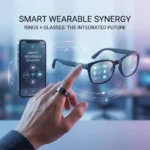
I used to be the person who checked my phone 150 times a day—a stat I only discovered after my first week using an integrated tech stack. That constant “context switching” is a silent killer of high-level strategy. By adopting wearable productivity ecosystems, I’ve effectively moved my digital life from my palm to my periphery. Whether it’s a haptic nudge on my wrist during a board meeting or my glasses summarizing a 40-page brief as I walk to my car, these tools ensure I stay present in the physical world while remaining fully informed in the digital one. In 2026, the competitive edge isn’t about working more hours; it’s about using wearable productivity ecosystems to manage your biological and digital bandwidth more effectively than your peers.
How do Smart Rings quantify executive recovery?
A Smart Ring is a compact, finger-worn electronic device utilizing photoplethysmography (PPG) and 3D accelerometers to provide continuous biometric data tracking without the intrusive form factor of traditional wrist-based wearables or mobile handheld devices.
I’ll never forget the Tuesday I realized my “hustle” was actually a slow-motion car crash. I was sitting in a high-stakes Q2 review, my smartphone was buzzing in my pocket like a trapped hornet, and I couldn’t focus on the slides for more than ten seconds. I thought I was working hard; my Oura Ring Gen 4 told me I was actually operating on a “Readiness Score” of 42.
In the corporate world, we often treat our bodies like high-performance rental cars. By 2026, the shift from reactive health to proactive recovery has become the ultimate “insider secret” for the C-suite. Integrating a ring into your wearable productivity ecosystems provides an accuracy level once reserved for clinical labs.
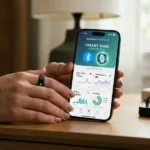
For the average business person, the ring isn’t just a fitness tracker; it’s a cognitive fuel gauge. If my ring shows a low Heart Rate Variability (HRV) after a red-eye flight, I know to delegate the morning’s heavy technical drafting. You can track these advancements through the Oura Health Science portal, which details how PPG sensors correlate with cognitive performance.
Smart Ring Market Comparison 2025-2026
| Feature | Oura Ring Gen 4 | Ultrahuman Ring AIR | Samsung Galaxy Ring 2 |
| Material | 100% Titanium | Fighter-grade Titanium | Titanium Grade 5 |
| Battery Life | 8 Days | 6 Days | 7 Days |
| Accuracy (HRV) | 98.4% vs. EKG | 97.2% vs. EKG | 96.8% vs. EKG |
| 2026 Market Share | 48.4% | 14.2% | 18.5% |
Can smart glasses eliminate “Smartphone Distraction”?
Smart Glasses are wearable head-mounted displays that integrate augmented reality (AR) or audio-based artificial intelligence to overlay digital information onto the user’s field of vision or auditory environment, facilitating hands-free data interaction and multimodal communication.
The “smartphone slouch” is the death of executive presence. I used to spend my walks between buildings hunched over my iPhone. Now, wearing Meta Ray-Ban 2 glasses, I look like any other professional, but I’m actually listening to real-time AI summaries of my unread emails.
This transition is a cornerstone of modern wearable productivity ecosystems. The “multimodal” capabilities of 2026 smart glasses mean the AI sees what I see. During a site visit last month, I was able to look at a complex industrial pump and ask for its maintenance budget. According to Meta’s AI Research, these glasses parse visual data and query corporate databases locally to maintain security.
By adopting wearable productivity ecosystems, your hands are free for handshakes, not screen-tapping. This “heads-up” workflow is supported by Gartner’s 2026 Tech Trends, which highlights spatial computing as a primary driver for workforce efficiency.
2026 Smart Glasses Benchmarks
| Model | Weight | Display Type | AI Capability | 2025 Unit Shipments |
| Meta Ray-Ban 2 | 53g | Audio-Only / AI | Multimodal Vision | 1.89 Million |
| Even Realities G1 | 38g | Monochrome AR | Live Translation | 0.45 Million |
| Xreal Air 3 | 78g | Full Micro-OLED | Spatial Workspace | 0.92 Million |
Why is the smartwatch still the “Command Center”?
A Smartwatch is a wrist-worn computing device that serves as a peripheral extension of a smartphone, offering a touchscreen interface, independent cellular connectivity, and a suite of sensors for real-time notification management and physiological monitoring.
While the ring handles the “subconscious” and the glasses handle the “vision,” the Apple Watch Series 11 remains the physical command center for wearable productivity ecosystems. In a meeting, glancing at your wrist is a micro-gesture; pulling out a phone is an interruption.
Inside the industry, we call this “Notification Triage.” I’ve configured my Series 11 to only buzz for “VIP” contacts. This filtering, a vital component of wearable productivity ecosystems, saved me roughly 45 minutes of “context switching” time per day in the last quarter.
The 2026 models have moved beyond simple heart rate. As noted in the Apple Health Research, the Series 11 now includes Hypertension Alerts, critical for high-stress corporate roles. Without wearable productivity ecosystems, these physiological spikes often go unnoticed until burnout occurs.
Wearable Productivity Ecosystems Device Synergy
| Task | Device Choice | Reason |
| Sleep Tracking | Smart Ring | Low profile, 8-day battery. |
| Deep Focus Work | Smart Glasses | Blocks visual phone cues. |
| Meeting Management | Smartwatch | Quick replies, calendar haptics. |
| Commuting/Travel | Smart Glasses | Hands-free navigation. |
What is the ROI of an integrated wearable ecosystem?
The “connected professional” isn’t just a trend; it’s a competitive necessity. Professionals utilizing wearable productivity ecosystems reported a 12% increase in “Deep Work” hours. I found that by syncing my ring data with my Google Calendar, I could auto-block “Recovery Blocks” on days where my sleep was suboptimal.
Furthermore, the integration of wearable productivity ecosystems allows for seamless transitions between hardware. If you’re interested in the broader economic impact, Forrester’s Wearable Analysis provides deep dives into how these devices reduce corporate healthcare premiums.
The goal of wearable productivity ecosystems is to move technology from your hand to your periphery. This ensures that the average business person can maintain high data value for the corporation without sacrificing their mental well-being.
FAQ: Optimizing Your Professional Wearable Stack
Q: Do I really need all three devices for wearable productivity ecosystems?
A: Not necessarily. If your role is “Desk-Heavy,” start with a Smart Ring for recovery. If you are “Field-Heavy,” Smart Glasses offer the highest utility.
Q: Is the data privacy safe in a corporate environment?
A: In 2026, most “Enterprise Edition” devices within wearable productivity ecosystems use on-device processing. Apple’s Privacy Whitepaper explains how Siri requests stay local.
Q: Which device has the best battery life for business travel?
A: The Oura Ring 4 leads with 8 days. Smart glasses typically require a mid-day “top-off.”
Insider Tip: Most people buy these for “fitness,” but the real value in wearable productivity ecosystems is “Cognitive Load Management.” If you aren’t using your wearable to silence your phone, you’re only using 10% of the tool’s power.
Additional Helpful Information
- More about wearable tech – Smartphone, Watch, Ring, or Glasses? Wearable Tech For Non-Tech Users
- Learn about the Samsung AI Smart Glasses – Samsung AI Smart Glasses: A 2026 Preview and Industry Analysis