
Key Takeaways
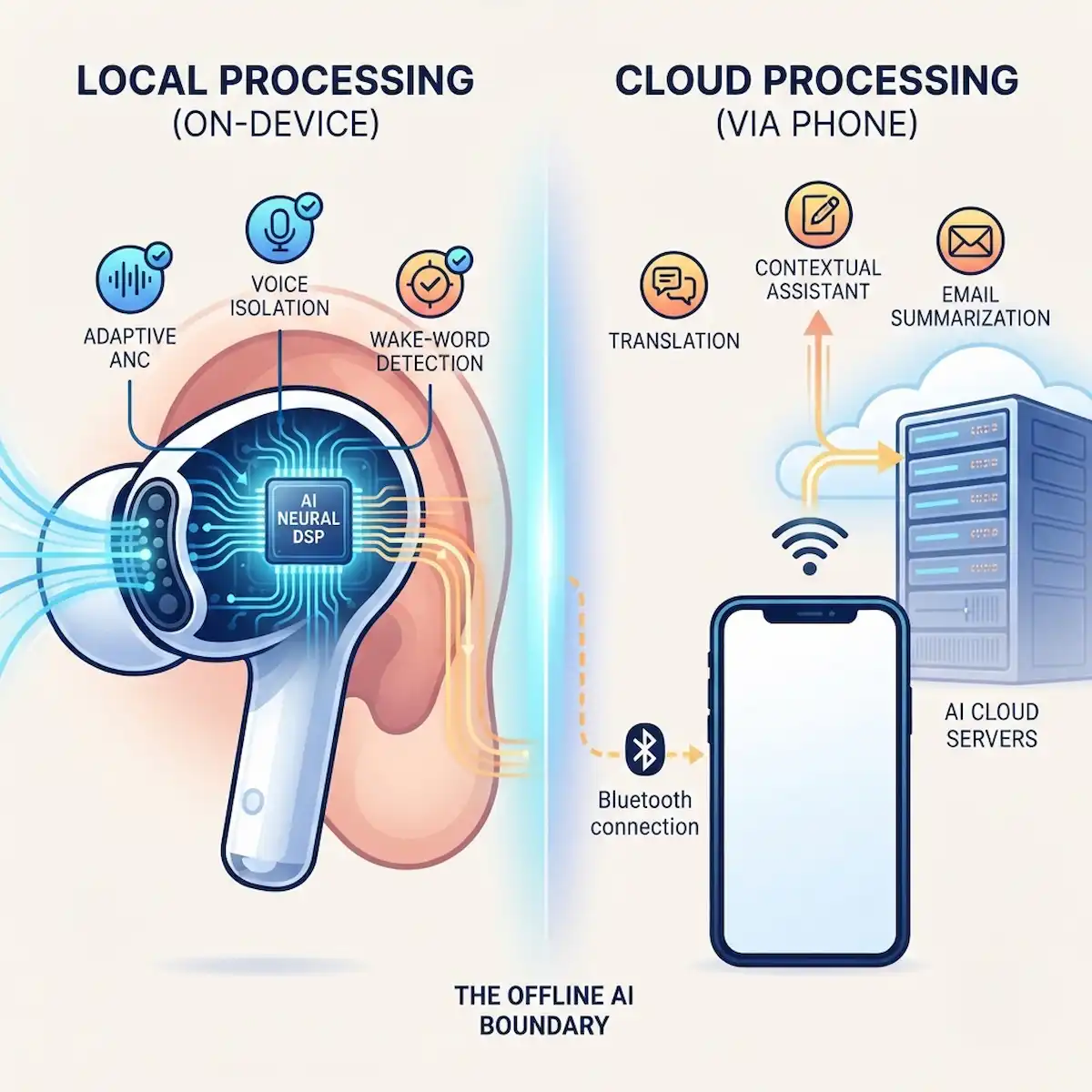
- Local Processing Reality: Active noise cancellation, real-time beamforming, and basic wake-word detection run entirely on local silicon inside modern earbuds or your phone, requiring zero internet connectivity.
- The Cloud Divide: Complex natural language generation, global translation models with deep contextual nuance, and multi-turn voice assistant queries routinely push your voice data to remote servers via your mobile data connection.
- Privacy Trade-offs: Running tasks locally safeguards sensitive audio streams from corporate data harvesting, but cloud processing remains necessary for heavy computational loads that exceed low-power silicon capabilities.
- Platform Control: Both Android and iOS offer toggle settings to restrict background data and cloud handoffs, though mastering these controls requires navigating deep system menus.
Demystifying The Offline AI Earbud Boundaries In Wireless Earbuds
The marketing language surrounding modern wireless earbuds often blurs the line between magical local intelligence and quiet data handoffs to remote servers. When a pair of wireless pods claims to understand speech instantly, figuring out whether that calculation happened on the tiny chip resting inside your ear canal or halfway across the world in a server farm is rarely straightforward. Learn more about offline ai earbud boundaries.
When evaluating modern audio gear, understanding offline ai earbud boundaries helps clarify data privacy realities and performance expectations. Local processing utilizes micro-power neural units embedded directly in hardware platforms like the Qualcomm Snapdragon S7 Sound Platform or Apple’s custom silicon, executing audio tasks instantly with zero latency. Conversely, heavy-duty language synthesis demands massive server clusters, forcing a silent data trip through your phone’s cellular connection. Understanding where this boundary lies helps define offline ai earbud boundaries for privacy-conscious users.
Which smart earbud features actually process locally on your hardware?
Local processing relies entirely on dedicated digital signal processors and micro-neural units embedded within the earbud or the host phone, bypassing external networks completely.
When examining offline ai earbud boundaries, features anchored entirely to local silicon include adaptive active noise cancellation, low-level acoustic beamforming, physical touch gesture parsing, and basic local keyword spotting. When wind noise buffets against an outer microphone, the internal signal processor adjusts phase cancellation waveforms in microseconds. This calculation happens locally because routing ambient street noise to a cloud server and back would introduce a noticeable audio delay, rendering real-time acoustic adjustments impossible. For developers and hardware enthusiasts studying offline ai earbud boundaries, understanding low-power silicon constraints is critical.
| Feature Category | Processing Location | Hardware Dependency | Network Requirement |
| Active Noise Cancellation | Local Chip | Earbud DSP / NPU | None |
| Beamforming & Voice Isolation | Local Chip | Multi-mic Array / Codec | None |
| Wake-Word Trigger | Local Chip | Ultra-low Power Sensor Hub | None |
| Complex Voice Synthesis | Cloud Server | Remote Data Center | High-speed Cellular / Wi-Fi |
| Deep Contextual Translation | Hybrid / Cloud | Phone NPU or Cloud API | Recommended |
What tasks secretly force a cloud connection through your phone?
Cloud handoffs occur the moment an audio query demands heavy semantic reasoning, multi-language conversational generation, or access to vast external knowledge bases.
When analyzing offline ai earbud boundaries during multi-step assistant queries, users often overlook how much data leaves the local device. When asking an assistant to summarize an incoming email thread or execute a multi-step calendar command, the local earbud chip lacks the RAM and thermal headroom to host the multi-billion parameter model required. Instead, your voice is captured, compressed via standard Bluetooth codecs, handed off to the companion app on your phone, and beamed over a cellular or Wi-Fi link to a remote data center. This silent transit exposes audio telemetry to third-party servers, highlighting a distinct privacy boundary that basic product packaging rarely details when discussing offline ai earbud boundaries.
How can you configure Android and iPhone settings to control local versus cloud data paths?
Managing how data flows from your audio accessories to external servers requires adjusting specific privacy toggles within mobile operating systems. Securing offline ai earbud boundaries on mobile platforms involves deep menu navigation.
Android Configuration Steps
- Open the main Settings application on your device.
- Navigate to the Apps menu and select your earbud’s companion management application.
- Tap on Mobile data & Wi-Fi to inspect background transmission permissions.
- Toggle off Background data to block the application from uploading voice logs when the app is minimized.
- Return to Privacy settings, open Permission manager, and restrict continuous microphone access to when the app is actively open on screen to maintain strict offline ai earbud boundaries.
iPhone Configuration Steps
- Open the Settings application on your device.
- Scroll down and select your specific earbud companion application from the main list.
- Locate the Background App Refresh toggle and switch it to the off position.
- Tap on Cellular Data within the same menu and disable it to prevent the companion software from utilizing cellular networks for cloud syncing.
- Navigate to Privacy & Security, select Microphone, and review which utilities maintain permanent audio permissions to protect offline ai earbud boundaries against unwanted data leaks.
What are the real-world use cases where the offline boundary matters most?
Evaluating the offline boundary becomes critical across distinct operational environments where connectivity, speed, and privacy dictate success.
International Travel and Remote Exploration
Navigating remote transit hubs or international markets often exposes dead zones where cellular networks fail completely. Offline-capable translation models running on local hardware maintain basic phrase conversion and directional assistance without data roaming fees. Devices relying strictly on cloud APIs stall out instantly when data signals drop, leaving travelers stranded without functional communication tools. When evaluating gear for global transit, maintaining strict offline ai earbud boundaries ensures reliable operation underground or in remote valleys.
Secure Corporate Environments and Legal Consultations
Workplace discussions involving proprietary intellectual property or legally protected client data cannot tolerate third-party server logging. Professionals utilizing local-only acoustic modes ensure that spoken conversations never leave the physical boundaries of their immediate device ecosystem, maintaining strict compliance with internal data governance policies. Respecting offline ai earbud boundaries in boardrooms prevents accidental leakage of confidential meeting audio.
Frequently Asked Questions
Do wireless earbuds record audio continuously even when not in an active call?
Active listening buffers run locally to monitor for specific wake words or environmental shifts, but audio data is systematically overwritten in volatile memory unless a trigger phrase is detected or a manual recording session begins, preserving offline ai earbud boundaries.
Does turning off cloud features degrade active noise cancellation performance?
No. Active noise cancellation is a pure hardware and digital signal processing function that operates independently of cloud connectivity or companion application servers, remaining fully functional within local offline ai earbud boundaries.
Can software updates transform a cloud-dependent earbud into a fully offline device?
Only partially. While software optimizations can compress smaller machine learning models to run on local silicon, hardware limitations regarding RAM capacity and thermal dissipation cap what local processors can achieve outside of strict offline ai earbud boundaries.
Additional Helpful Information
Learn more about earbuds and translation – Testing Real-Time Translation Latency: Earbuds vs Smartphone Apps