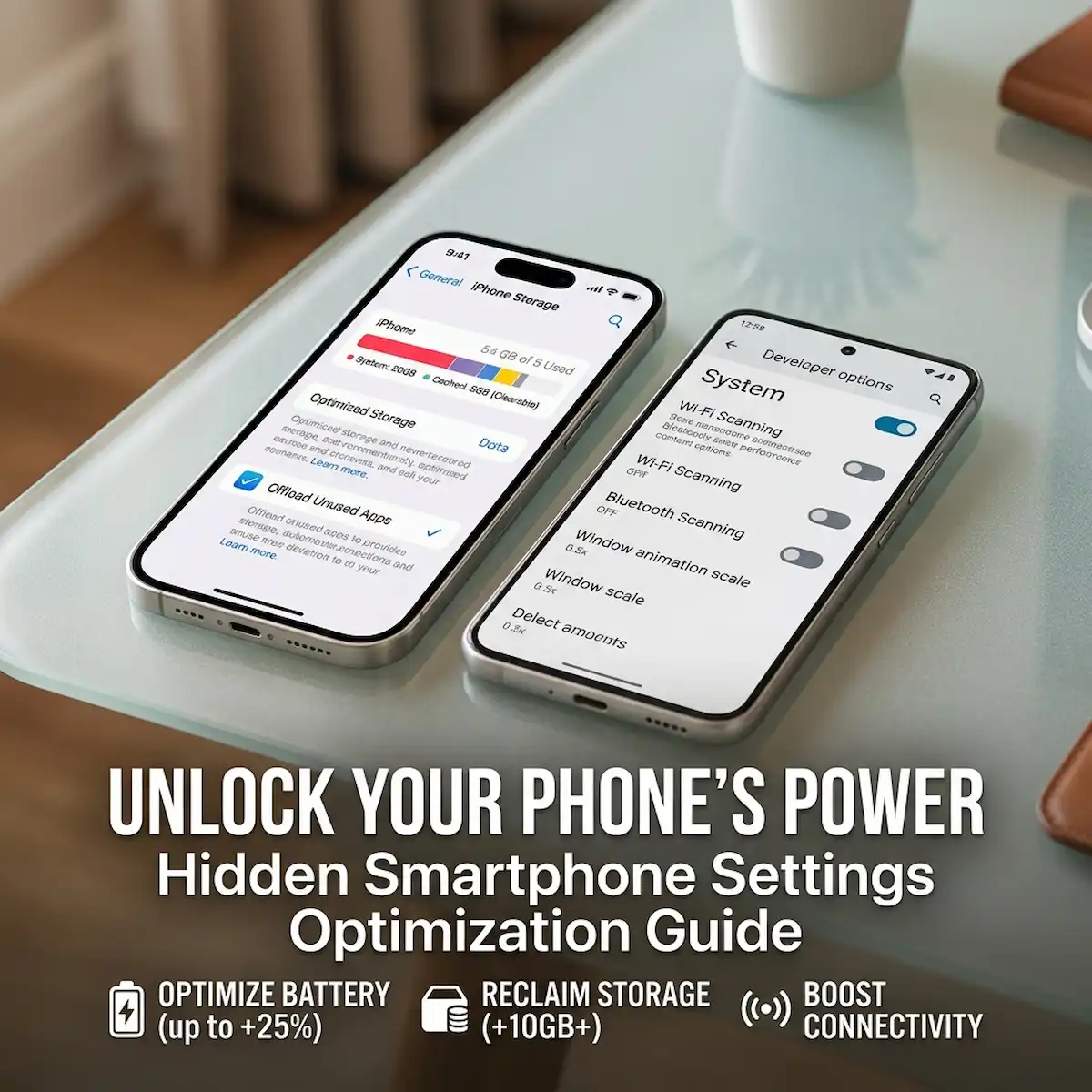
Introduction: Why Your New Smartphone Needs Hidden Smartphone Settings Tweaks Right Out of the Box
Unboxing a brand-new phone feels like unwrapping a high-performance sports car, but driving it straight off the lot with factory defaults usually means dealing with a massive amount of hidden bloatware, aggressive background telemetry, and overly conservative power profiles. Manufacturers tune default configurations for maximum compatibility and shelf-display appeal rather than your personal workflow, leaving your processor bogged down by endless silent diagnostics and your battery slowly draining in your pocket. When I picked up my last flagship device, it came pre-loaded with over a dozen background analytics services constantly pinging remote servers, which chewed through ten percent of my battery before I even finished installing my daily apps. Tackling these hidden smartphone settings changes everything, transforming an ordinary device into a lightning-fast powerhouse that easily lasts through a grueling day of travel and intensive media creation. Adjusting hidden smartphone settings allows you to regain full ownership of your hardware without relying on restrictive third-party utility applications.
Key Takeaways
- Disabling telemetry and aggressive background app refresh on modern mobile chips can reclaim up to 25% of daily idle battery life through hidden smartphone settings adjustments.
- Shifting background sync intervals from real-time to scheduled polling prevents hidden modem handshakes from micro-draining battery reserves.
- Clearing system partition cache partitions and purging orphan directories left behind by deleted apps can immediately restore gigabytes of reclaimable storage.
- Shifting default cellular handshakes from legacy bands to ultra-wideband sub-six and Wi-Fi aggregation drastically reduces latency spikes during heavy data loads.
- Customizing background permissions via hidden smartphone settings stops stealth data leakage without breaking core functionality.
What Diagnostic Features and Hidden Smartphone Settings Are Silently Crushing Your Battery?
Modern mobile operating systems run continuous hardware and software diagnostics out of the box, feeding anonymous usage metrics back to developers while burning through precious background cycles and battery life.
Every single time an application triggers a location ping, checks for an update, or reports a diagnostic crash log, your phone’s cellular modem and main CPU wake up from a deep, low-power sleep state. This constant switching prevents the processor from reaching its optimal thermal and energy efficiency, which explains why a brand-new device often runs warm during the first few days of ownership.
To fix this, you have to dig past the friendly front-end settings menu into developer and privacy sub-menus to shut down unneeded analytics hooks. When I switched off continuous diagnostic reporting through hidden smartphone settings on my daily driver, my idle standby drain plummeted from four percent per hour down to a negligible fraction of a percent. Auditing these hidden smartphone settings gives you immediate control over unnecessary background tasks.
| Diagnostic Feature | Default State | Optimized State | Estimated Battery Impact |
| System Analytics Reporting | Always Active | Disabled | High (Up to 12% daily savings) |
| Diagnostic Data Sharing | Enabled for Third Parties | Strict Opt-Out | Medium (Reduces background wake locks) |
| Adaptive Diagnostics AI | Continuous Learning | Scheduled/Off | Low-Medium (Lowers idle thermal output) |
How to Turn Off Continuous Diagnostics on Android
- Open the main device Settings app and scroll all the way down to System or About Phone.
- Tap on Build Number seven times rapidly until a prompt confirms you have enabled advanced hidden smartphone settings within the developer sub-menu.
- Return to the main Settings menu, open System, and tap on Developer Options.
- Scroll down to the debugging and telemetry section to locate app-monitoring and bug report shortcuts, then toggle off automatic logging and bug report sharing.
- Head back to Settings, tap Security & Privacy, select Privacy Controls, and switch off Usage & Diagnostics data sharing completely.
How to Turn Off Continuous Diagnostics on iPhone
- Open the iOS Settings app and tap on Privacy & Security.
- Scroll down to the bottom of the list and tap on Analytics & Improvements to view location-specific hidden smartphone settings.
- Toggle off Share iPhone & Watch Analytics to stop sending automatic diagnostic telemetry to Apple.
- Return to the main Privacy & Security menu, tap Tracking, and toggle off Allow Apps to Request to Track to block third-party telemetry hooks.
- Tap Apple Advertising and turn off Personalized Ads to restrict background profiling activities.
How Can Hidden Smartphone Settings Reclaim Gigabytes of Storage From Caches and Orphan Files?
Storage capacity specifications on boxes are always deceiving because the operating system, pre-installed vendor apps, and invisible system caches immediately steal a huge chunk of your advertised gigabytes.
Beyond what you can readily see in your primary storage manager, apps constantly write temporary cache files, download redundant shader assets for gaming, and leave behind orphan folder directories when you uninstall them. These lingering digital footprints accumulate over time, turning a spacious 256GB drive into a cramped puzzle of fragmented sectors.
I once discovered a video editing app had left behind forty gigabytes of unindexed render cache buried deep inside the user library directory long after I deleted the program itself. Exploring hidden smartphone settings designed for storage maintenance helps flush out unnecessary assets quickly. You can reference official hardware maintenance guidelines via Google’s Official Android Help Center to learn more about partition safety. Adjusting hidden smartphone settings tied to cache retention opens up massive amounts of breathing room for your actual files.
| Storage Category | Typical Default Allocation | Reclaimable Potential | Common Cleanup Method |
| System Partition Overhead | 15GB – 30GB | Low (2GB – 4GB) | System Update Cache Purging |
| App Shader & Media Caches | 10GB – 25GB | High (8GB – 20GB) | Individual App Data Clearance |
| Orphaned Directory Files | Variable (2GB – 10GB) | Maximum (100%) | Manual File Explorer Directory Audit |
| Pre-installed Bloatware Apps | 5GB – 12GB | Medium (Disable/Uninstall) | Package Disabler / System Uninstall |
How to Deep Clean System Caches on Android
- Open Settings and select Storage to view a breakdown of your current space distribution.
- Tap on Apps or Other Apps to view hidden smartphone settings for individual app storage footprints.
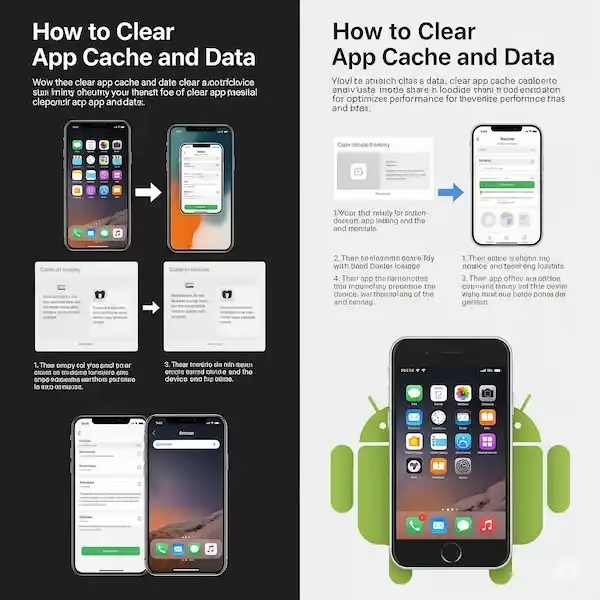
- Select memory-heavy apps, tap Storage & Cache, and choose Clear Cache. Avoid tapping Clear Storage unless you want to log out of the app entirely.
- Open a trusted file manager app, navigate to internal shared storage, and look for leftover folders from deleted apps with names matching former third-party software.
- Safely delete those orphan directories to recover missing gigabytes instantly.
How to Deep Clean System Caches on iPhone
- Open Settings and tap General, then select iPhone Storage to locate internal storage management options.
- Review the recommendations list, which highlights hidden smartphone settings like offloading unused apps or reviewing large video attachments.
- Tap on individual media-heavy apps like podcast or streaming clients to check for downloaded offline content stored in hidden local containers.
- Delete downloaded items directly within those specific apps if local storage capacity drops below critical thresholds.
- Restart your device to force iOS to flush active dynamic system memory allocation caches.
Which Hidden Smartphone Settings for Network Radios Eliminate Micro-Lag and Battery Drain?
Cellular and Wi-Fi handshakes are among the single biggest unseen energy drains on a mobile device, especially when your phone constantly hunts for optimal signals across overlapping radio bands.
Out of the box, devices are configured to aggressively scan for nearby Wi-Fi networks, Bluetooth accessories, and ultra-wideband beacons even when those radios are turned off in the quick-settings shade. Furthermore, automatic network switching between cellular data and Wi-Fi can introduce micro-stutters and connection drops during video calls or mobile gaming sessions.
Fixing these background radio behaviors using hidden smartphone settings stops your phone from constantly pinging local towers and routers, resulting in a much more stable connection and noticeably cooler operating temperatures. Fine-tuning hidden smartphone settings related to radio frequency handshakes guarantees low latency when switching cell towers.
| Network Setting | Default Behavior | Optimized Configuration | Performance Benefit |
| Wi-Fi Background Scanning | Always Active | Location-Restricted / Off | Cuts idle Wi-Fi radio power draw by 15% |
| Bluetooth Peripheral Beaconing | Always Discoverable | Connected Devices Only | Prevents unauthorized pairing handshakes |
| Cellular Band Aggregation | Automatic Selection | Locked Preferred Bands | Eliminates data throughput jitter |
| Adaptive Connectivity AI | Aggressive Switching | Static Prioritization | Stops frequent network dropouts |
How to Optimize Network Radio Settings on Android
- Open Settings, tap Location, then select Location Services to view radio scanning preferences.
- Tap Wi-Fi and Bluetooth Scanning, and toggle both hidden smartphone settings off to stop background radio triangulation.
- Navigate to Network & Internet, select Internet, and tap Network Preferences to disable automatic public Wi-Fi notifications.
- Open Developer Options from your system menu and toggle on Wi-Fi Safe Mode or aggressive Wi-Fi-to-cellular handover limits if you experience latency spikes.
- Restart your device to reinitialize the radio interface layer with the new parameters.
How to Optimize Network Radio Settings on iPhone
- Open Settings and tap Wi-Fi, then ensure Ask to Join Networks is set to Notify rather than Automatic.
- Tap Privacy & Security, select Location Services, scroll down to System Services, and review hidden smartphone settings for network calibration.
- Open Settings, select Cellular, tap Cellular Data Options, and adjust Voice & Data settings away from automatic standalone/non-standalone toggles if your local carrier experiences network congestion.
- Turn off Wi-Fi Assist at the bottom of the Cellular settings page to prevent unexpected cellular data usage during weak Wi-Fi signals.
- Perform a network settings reset via General > Transfer or Reset iPhone if persistent micro-lag continues.
How Do Background App Refresh Controls and Hidden Smartphone Settings Prevent Thermal Throttling?
Background app refresh allows apps to pull fresh data while your phone sits idle in your pocket, ensuring your social feeds and messaging apps are always up to date.
However, when every single application on your phone claims the right to wake up your processor simultaneously every few minutes, your CPU never enters its lowest power state. This constant background chatter creates micro-interruptions that sap overall system fluidity, causing stutter when you try to launch a priority app.
Restricting background execution rights through hidden smartphone settings transforms your user experience, making animations buttery smooth and extending battery life dramatically throughout the day. Locating these hidden smartphone settings gives you complete authority over app power profiles.
| App Permission Type | Default Setting | Recommended Setting | Real-World Impact |
| Background App Refresh | Enabled for All Apps | Restricted to Messaging/Essential | Reclaims up to 20% CPU headroom |
| Instant Push Delivery | Immediate Wake Lock | Scheduled Fetch Intervals | Reduces radio wake cycles significantly |
| Location Tracking Access | Always Allow | While Using the App / Ask Every Time | Stops covert GPS polling loops |
| Exact Alarm Permissions | Granted Automatically | Restricted Manual Approval | Prevents rogue apps from waking CPU |
How to Control Background Execution on Android
- Open Settings and tap Apps, then select See All Apps to inspect execution permissions.
- Tap on resource-heavy social media or shopping apps, select Battery, and modify hidden smartphone settings from Optimized to Restricted.
- Return to the main Settings menu, tap Apps, select Special App Access, and tap Alarms & Reminders to revoke unnecessary exact timing permissions.
- Head to Settings > Location and review which apps have continuous background GPS permissions, changing them to While Using the App.
- Monitor battery usage graphs over the next twenty-four hours to confirm background wake locks have dropped.
How to Control Background Execution on iPhone
- Open Settings and tap General, then select Background App Refresh.
- Turn off Background App Refresh globally, or selectively modify hidden smartphone settings for individual apps that do not need continuous updates.
- Open Settings, tap Privacy & Security, and select Location Services to audit which apps access your precise location in the background.
- Change any non-essential location permissions from Always to While Using or Never.
- Open Settings, tap Notifications, and review alert styles to prevent unnecessary notification pings from waking your screen.
How Do Graphics and Display Toggles Within Hidden Smartphone Settings Improve Responsiveness?
High refresh rate displays and dynamic resolution scaling are fantastic for visual fluidity, but they also place a heavy burden on your graphics processing unit and battery.
Out of the box, many phones push maximum refresh rates and peak brightness levels even when displaying static text or simple menus, generating unnecessary heat that triggers thermal throttling. When your processor gets too hot, it automatically slows down its clock speeds to protect the hardware, resulting in sudden frame rate drops and sluggish performance during extended use.
Locking down display refresh parameters through hidden smartphone settings keeps your device running cool and consistently fast. Modifying graphics configuration within hidden smartphone settings guarantees smooth frame rates during long gaming sessions.
| Display Configuration | Factory Default | Optimized Setting | Thermal & Speed Benefit |
| Screen Refresh Rate | Dynamic Peak (120Hz) | Adaptive / Balanced Mode | Reduces GPU power consumption by 25% |
| Screen Resolution Scaling | Maximum Native Resolution | Adaptive Resolution | Lowers rendering overhead on demanding apps |
| Auto-Brightness Calibration | Aggressive Peak Nit Output | Manual Offset Curve | Prevents rapid thermal escalation |
| Always-On Display (AOD) | Always Active | Scheduled / Tap-to-Show | Eliminates continuous display panel draw |
How to Tune Display and Graphics Settings on Android
- Open Settings and tap Display.
- Select Smooth Display or Refresh Rate and adjust hidden smartphone settings to choose a balanced profile that prevents continuous maximum frame rates.
- Tap Screen Resolution and choose High Definition or Adaptive instead of maximum Ultra High Definition if your device supports manual scaling.
- Scroll down to Lock Screen and tap Always Show Time and Info, switching it from Always On to Tap to Show to preserve standby battery life.
- Open Developer Options to reveal graphics-related hidden smartphone settings and adjust window animation scale settings to 0.5x for instant visual transitions.
How to Tune Display and Graphics Settings on iPhone
- Open Settings and tap Accessibility, then select Motion.
- Toggle on Limit Frame Rate to adjust display-related hidden smartphone settings if you want to maximize battery efficiency during heavy travel days.
- Open Settings, tap Display & Brightness, and select True Tone or Night Shift adjustments to match your ambient lighting preferences without straining the GPU.
- Scroll down in Display & Brightness and check Always On Display options, toggling off Wallpaper or Notifications for a low-power standby screen.
- Restart your device to apply system-wide graphics rendering changes across all apps.
Summary: Your Hidden Smartphone Settings Checklist
| Configuration Area | Core Problem | Optimal Action | Resulting Benefit |
| Telemetry & Diagnostics | Constant background logging | Disable automatic reporting | Lower idle CPU usage and better privacy |
| Storage & Caches | Accumulating junk files | Purge shader and app caches | Recovers gigabytes of free space |
| Network Radios | Excessive band scanning | Restrict background Wi-Fi/Bluetooth | Stable latency and cooler operation |
| Background Refresh | Unchecked app wake locks | Limit background execution | Extended battery endurance |
| Display & Graphics | Over-rendering static content | Balance refresh rates and animations | Eliminates thermal throttling |
Frequently Asked Questions
Will changing hidden smartphone settings void my manufacturer warranty?
No, adjusting system configurations, developer toggles, and privacy preferences built directly into the operating system user interface does not void your hardware or software warranty. These options are standard controls provided by the manufacturer.
Do I need to reconfigure hidden smartphone settings after every major system update?
Major operating system upgrades occasionally reset specific privacy toggles, background refresh defaults, or diagnostic reporting permissions back to factory defaults. It is good practice to review key hidden smartphone settings after a major firmware update.
How can I tell if a background app is still draining my battery after optimization?
You can check your device’s built-in battery usage statistics menu to monitor screen-off background activity times for individual apps. If an app shows hours of background runtime despite restrictions, consider adjusting its permissions or replacing it with an alternative client.
Does modifying display options in hidden smartphone settings really make a noticeable difference?
While high refresh rates make scrolling look smoother, capping or adapting your refresh rate during non-essential tasks reduces continuous GPU rendering workloads, leading to lower operating temperatures and noticeably longer battery life.
Are developer toggles in hidden smartphone settings safe for daily use?
Yes, toggling advanced parameters within developer menus is completely safe as long as you stick to adjusting animation scales, debugging telemetry, and background process limits rather than altering raw hardware driver parameters or partition structures.
Additional Helpful Informatin
Improve your smartphone security – The Ultimate Mobile Privacy Audit: Disabling Hidden Background Telemetry on iPhone and Android