Key Takeaways
- Biometric hearables now feature optical heart-rate sensors capable of clinical-grade data collection, matching the accuracy of traditional chest straps during high-intensity training.
- Body temperature tracking via ear canal sensors provides an internal core reading that reacts faster to physiological changes than traditional wrist-based skin temperature monitors.
- Hearing aid compliance features bridge the gap between consumer audio gear and FDA-regulated medical devices, allowing everyday earbuds to double as clinical amplification tools.
- Integrating advanced sensors into compact acoustic housings requires overcoming major design hurdles, including acoustic interference, battery drain, and thermal dissipation.
- Configuring continuous health tracking on mobile devices involves navigating specific permission settings for both Android and iOS platforms to ensure uninterrupted data syncing.
What Are Biometric Hearables and How Do They Measure Vital Signs?
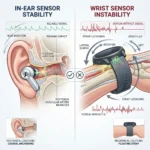
Biometric hearables represent the convergence of micro-acoustic engineering and advanced physiological sensor arrays, utilizing the highly vascularized anatomy of the ear canal to capture continuous health data. When you pop a pair of modern fitness buds into your ears, you are essentially wearing a miniature diagnostic clinic. The ear canal offers an exceptionally stable optical window because the skin is thin and the underlying blood vessels are close to the surface, making it far superior to the wrist for capturing clean photoplethysmography signals. Unlike a smartwatch that slides around when you sweat during a heavy run, a well-fitted earbud stays securely anchored against the tragus and concha.
I remember wrestling with bulky chest straps back when tracking a workout meant dealing with chafing straps and unreliable Bluetooth connections that dropped out halfway through a long bike ride. Today, having optical heart-rate sensors built directly into the housing of buds like the Beats Powerbeats Pro 2 means you get continuous medical-grade monitoring without adding an extra piece of gear to your routine. The acoustic seal keeps ambient light out, which drastically reduces optical noise and gives you cleaner data than most wrist-worn trackers can manage.
The engineering challenge behind stuffing PPG sensors, accelerometers, and infrared temperature probes into a device designed primarily to pump out music is staggering. Acoustic engineers have to balance driver airspace with sensor placement so that the sound quality does not suffer while the biometric hardware collects data. The table below breaks down the technical differences between traditional wrist-based tracking and modern ear canal biometric monitoring.
| Metric / Feature | Wrist-Based Wearables | Biometric Hearables | Clinical Significance |
| Perfusion Site | Radial artery / surface capillaries | Posterior auricular artery / ear canal | Ear canal provides higher blood flow density for cleaner optical reads |
| Motion Artifacts | High susceptibility to arm swing and slippage | Low susceptibility due to snug anchor fit | Reduces false-positive irregular heart rhythm flags |
| Core Temperature | Peripheral skin temperature estimation | Tympanic membrane / ear canal core proxy | Closer correlation to true internal core body temperature |
| Data Sample Rate | Typically 1 Hz to 5 Hz continuous | Up to 50 Hz for high-precision HRV tracking | Essential for capturing subtle autonomic nervous system shifts |
Why Is the Ear Canal Better Than the Wrist for Health Tracking?
The ear canal provides a pristine physiological environment for biometric monitoring because it bypasses the thick stratum corneum and variable pigmentation that often disrupt optical sensors on the wrist. When you rely on a smartwatch, minor shifts in positioning, loose bands, and ambient light leakage can throw off your photoplethysmography readings, resulting in jagged heart-rate graphs during interval training. The ear canal, by contrast, is a protected cavity with a dense bed of capillaries supplied by the external carotid artery. This anatomical advantage allows biometric hearables to capture pulse waves with remarkable clarity, giving you reliable data whether you are sitting at your desk or sprinting up a steep hill.
Working with sports scientists over the years, I have noticed a massive shift away from wrist-dominant telemetry toward head-borne sensors, especially for serious athletes and clinical researchers. The head experiences less erratic gravitational displacement during dynamic movement than the wrist, which translates to fewer motion artifacts in the raw data stream. Furthermore, the skin inside the ear canal is remarkably thin, allowing green and infrared LEDs to penetrate efficiently and return high-fidelity volumetric pulse measurements.
Beyond heart rate, this strategic anatomical placement unlocks accurate core body temperature tracking. Wrist devices only measure peripheral skin temperature, which fluctuates wildly depending on ambient weather, sweat evaporation, and local blood vessel constriction. The ear canal shares a direct thermal pathway with the tympanic membrane, which reflects internal hypothalamic temperature with high fidelity. The comparison below highlights why this physiological location makes biometric hearables uniquely suited for continuous health oversight.
| Physiological Parameter | Wrist Monitor Limitations | Ear Canal Advantage | Impact on User Insights |
| Heart Rate Variability (HRV) | Prone to dropping packets during high-cadence arm movements | Stable optical coupling minimizes signal dropout | Highly accurate recovery and stress tracking |
| Thermal Monitoring | Skewed by wind chill, sweat, and external air temp | Protected internal microclimate near the eardrum | Early detection of fever or metabolic stress |
| Blood Oxygen (SpO2) | Sensitive to tattoos, skin tone, and loose fit | Uniform tissue depth ensures consistent light absorption | Reliable nocturnal oxygen saturation profiling |
How Do Optical Heart-Rate Sensors and Body Temperature Trackers Work in Modern Earbuds?
Optical heart-rate sensors inside fitness-focused earbuds operate on the principle of photoplethysmography, shining alternating wavelengths of green, red, and infrared light into the tissue of the ear canal and measuring the varying amounts of light reflected back as blood pulses through the microvascular bed. When your heart beats, blood volume in the ear canal increases, absorbing more light; between beats, volume decreases, and more light reflects back to the photodetector. Advanced algorithms parse these micro-fluctuations in real time to calculate your beats per minute and derive advanced metrics like beat-to-beat intervals.
Alongside optical sensors, modern biometric hearables integrate medical-grade negative temperature coefficient thermistors or infrared thermopiles. These tiny components measure the radiant heat emitted by the tympanic membrane and surrounding canal walls multiple times per second. Unlike a traditional digital thermometer that requires a static, one-time reading, continuous ear-based thermometry maps your thermal baseline over twenty-four hours, spotting subtle upward trends long before you feel overt symptoms of illness or overtraining.
The integration of these systems requires sophisticated micro-electro-mechanical systems architecture. Manufacturers must isolate the sensitive optical sensors and thermistors from acoustic vibrations generated by the speaker driver. If sound waves from your music cause microscopic flexing of the sensor housing, it introduces mechanical noise into the biometric stream—a phenomenon known as microphonic interference. Solving this engineering hurdle required acoustic designers to float sensor boards on dampening gels and decouple driver chambers from the outer shell.
What Are the Clinical Implications of Hearing Aid Compliance Features in Consumer Audio?
Integrating hearing aid compliance and over-the-counter amplification features into mainstream consumer earbuds marks a watershed moment in digital health, effectively dissolving the historical barrier between lifestyle audio gear and regulated audiological devices. Traditional hearing aids often carry a social stigma and a prohibitive price tag, leaving millions of individuals with mild-to-moderate hearing loss untreated. By embedding clinical-grade audiometric testing, custom frequency profiling, and real-time environmental processing into sleek everyday earbuds, manufacturers have turned consumer tech into an accessible entry point for auditory rehabilitation.
Navigating this transition has been fascinating to watch from an industry perspective, especially as regulatory bodies like the FDA established clear pathways for OTC hearing devices. Companies can now ship hardware that runs an automated in-app audiogram, measures your unique ear canal acoustics, and applies bespoke amplification curves directly to incoming environmental sounds—all without requiring a trip to an audiologist’s office. This shift transforms hearables into active therapeutic tools that protect vulnerable cochlear hair cells while enhancing speech intelligibility in noisy social settings.
The technical specifications required to pull this off are demanding. Real-time sound processing requires ultra-low-latency digital signal processing chips that can amplify soft conversational frequencies while instantly compressing sudden, loud impulse noises to protect the user’s residual hearing. Platforms like the Apple AirPods Pro regulatory updates highlight how consumer firmware updates successfully bridge this gap. The table below outlines how traditional hearing aids compare to modern clinical-grade biometric hearables across key functional domains.
| Feature / Capability | Traditional Prescription Hearing Aid | Biometric Hearable with OTC Compliance | Clinical and Practical Trade-offs |
| Regulatory Status | FDA-Class II Medical Device | FDA-Cleared OTC Hearing Aid / Consumer Hybrid | Consumer hybrids offer broader retail access with clinical-grade processing |
| Audiometric Customization | Performed in-clinic by licensed audiologist | Self-administered app-based audiogram test | App tests provide rapid baseline adjustment, though clinical verification remains superior for complex loss |
| Multi-Modal Integration | Focused strictly on acoustic amplification | Combines hearing support with fitness tracking, music, and calls | Multifunctional devices reduce hardware clutter for aging demographics |
| Acoustic Transparency | High-end directional microphone arrays | Advanced beamforming mics with adaptive ambient pass-through | Consumer chips now match directional noise cancellation of older clinical units |
How Can You Configure Continuous Health Tracking on Android and iPhone?
Setting up continuous health tracking on your smartphone requires establishing secure data permissions between your biometric hearables and your operating system’s health architecture. Because continuous optical heart-rate, temperature, and hearing compliance logs generate massive streams of sensitive personal data, both Android and iOS enforce strict privacy protocols that require manual opt-in for background sensor polling.
For Android users utilizing platforms like Health Connect, you need to ensure that the companion app for your hearables has unrestricted background execution rights. Go to your phone settings, select apps, find your hearable companion application, tap battery usage, and set it to unrestricted to prevent the operating system from killing background sensor sync routines. Next, open the Health Connect application, navigate to data access permissions, and explicitly grant read and write privileges for heart rate, body temperature, and audio exposure data.
For iPhone users leveraging Apple Health, the configuration relies on HealthKit permission bridges. When you first pair your biometric hearables, the companion app will prompt you to share data with the Health app. Navigate to your iPhone settings, tap privacy and security, select health, and choose your hearable app from the list to verify that toggles for heart rate, body temperature, and headphone audio levels are turned on. For comprehensive step-by-step guidance on syncing parameters, you can reference the Apple Support Guide. Ensuring these permissions are correctly aligned guarantees that your biometric data flows seamlessly into your daily trend dashboards without interruption.
What Real-World Use Cases Demonstrate the Power of Biometric Hearables?
Biometric hearables unlock practical use cases that extend far beyond casual fitness logging, proving invaluable in high-stakes professional environments, geriatric care, and clinical research. Consider endurance athletes navigating extreme weather conditions; monitoring core body temperature via the ear canal allows runners and cyclists to spot early signs of heat exhaustion before heatstroke sets in, far outperforming traditional pace or heart-rate metrics alone.
In occupational health, workers in high-noise industrial settings benefit from hearables that combine active noise reduction, hearing protection compliance logging, and physiological strain monitoring. If a worker’s heart rate spikes alongside elevated environmental noise levels, safety managers receive immediate alerts, preventing long-term noise-induced hearing loss and acute cardiovascular stress.
Another compelling use case lies in remote patient monitoring for aging populations. Adult children can monitor their parents’ daily step counts, resting heart rates, and hearing aid usage compliance through secure cloud dashboards linked to everyday earbuds. This passive health monitoring approach removes the friction of wearing dedicated medical alert buttons, integrating vital sign tracking into an accessory seniors already use for phone calls and media consumption.
What Are the Common Challenges and Limitations of Ear-Based Health Monitoring?
Despite the impressive engineering behind biometric hearables, several persistent challenges limit their universal adoption as primary diagnostic tools. Battery longevity remains a major bottleneck; running continuous photoplethysmography sensors, infrared thermopiles, and active noise-cancellation processors simultaneously drains lithium-ion coin cells in a matter of hours, requiring users to recharge their earbuds multiple times a day during heavy usage periods.
Another significant hurdle is physical fit and acoustic sealing. If an earbud shifts slightly in the user’s ear canal due to jaw movement while talking or chewing, the optical sensor loses proper contact with the skin, introducing motion artifacts and corrupting the continuous data stream. Unlike a wristband that can be strapped down tightly, an earbud relies on precise ear tip sizing to maintain both acoustic isolation and sensor stability, making universal sizing an ongoing design challenge for manufacturers.
Data privacy and regulatory compliance also present complex hurdles. Because biometric hearables capture intimate physiological metrics—including core body temperature, stress responses, and audiometric profiles—securing this data against unauthorized access or cloud breaches is paramount. Manufacturers must comply with stringent health data protection standards like HIPAA and GDPR, ensuring that continuous health streams transmitted from the ear canal to companion smartphone apps remain encrypted end-to-end.
Frequently Asked Questions
Are biometric hearables as accurate as chest straps for heart-rate monitoring?
Yes, modern biometric hearables utilizing ear-canal photoplethysmography match the accuracy of traditional ECG chest straps during most steady-state and interval training sessions. Because the ear canal is tightly sealed and rich in capillaries, it suffers from fewer motion artifacts than wrist-worn optical sensors.
Can biometric hearables diagnose medical conditions like fevers or arrhythmias?
Biometric hearables are designed for wellness tracking and early trend detection rather than definitive clinical diagnosis. While they can alert you to abnormal heart-rate spikes or sustained upward trends in core body temperature, any clinical concerns should be verified by a licensed medical professional.
Do I need a prescription to use hearing aid compliance features on consumer earbuds?
No, following regulatory changes permitting over-the-counter hearing aids, modern consumer earbuds equipped with audiometric testing and self-fitting amplification features can be purchased and configured directly by the consumer without a doctor’s prescription.
How does core body temperature tracking in the ear differ from wrist skin temperature?
Wrist devices measure peripheral skin temperature, which is heavily influenced by ambient air, sweat evaporation, and local blood flow changes. Ear canal sensors measure thermal radiation close to the tympanic membrane, providing a much closer proxy for true internal core body temperature.
Why do my earbud biometric readings drop out during intense workouts?
Data dropouts typically occur when heavy sweating or jaw movement causes the earbud to shift slightly inside the canal, breaking the optical seal required for accurate light reflection measurements. Ensuring you use the correct size ear tip can largely resolve this issue.
Additional Helpful Information
Read about earbuds for noise cancellation – Local Earbud Neural Processing for Noise Cancellation