
The Great Signal Deception
If you’ve ever stood in a crowded stadium with “full bars” and yet couldn’t even send a text, you’ve been a victim of the great signal lie. Most of us look at the top right of our iPhone or Android and assume our carrier is the one dropping the ball. The truth is that while the network matters, your 5G performance is actually dictated by the silicon modem inside your device.
In 2026, the gap between flagship connectivity and budget connectivity has never been wider. It isn’t just about raw speed anymore; it’s about modem intelligence—the ability to switch between frequency bands without overheating or giving up in an elevator. To understand why your experience differs from your friend’s on the same network, we have to look at the hardware driving your 5G performance.
Get The Fastest 5G Performance
I’ve spent the last few months testing the three heavy hitters—Snapdragon X80, Exynos 5400, and the Google Tensor G5—in the worst possible environments. Here is how they actually stack up when the going gets tough and your 5G performance is put to the test.
1. The Gold Standard: Snapdragon X80 (Qualcomm)
Found in: Samsung Galaxy S26 Ultra (US), iPhone 17 Pro series, and high-end flagships.
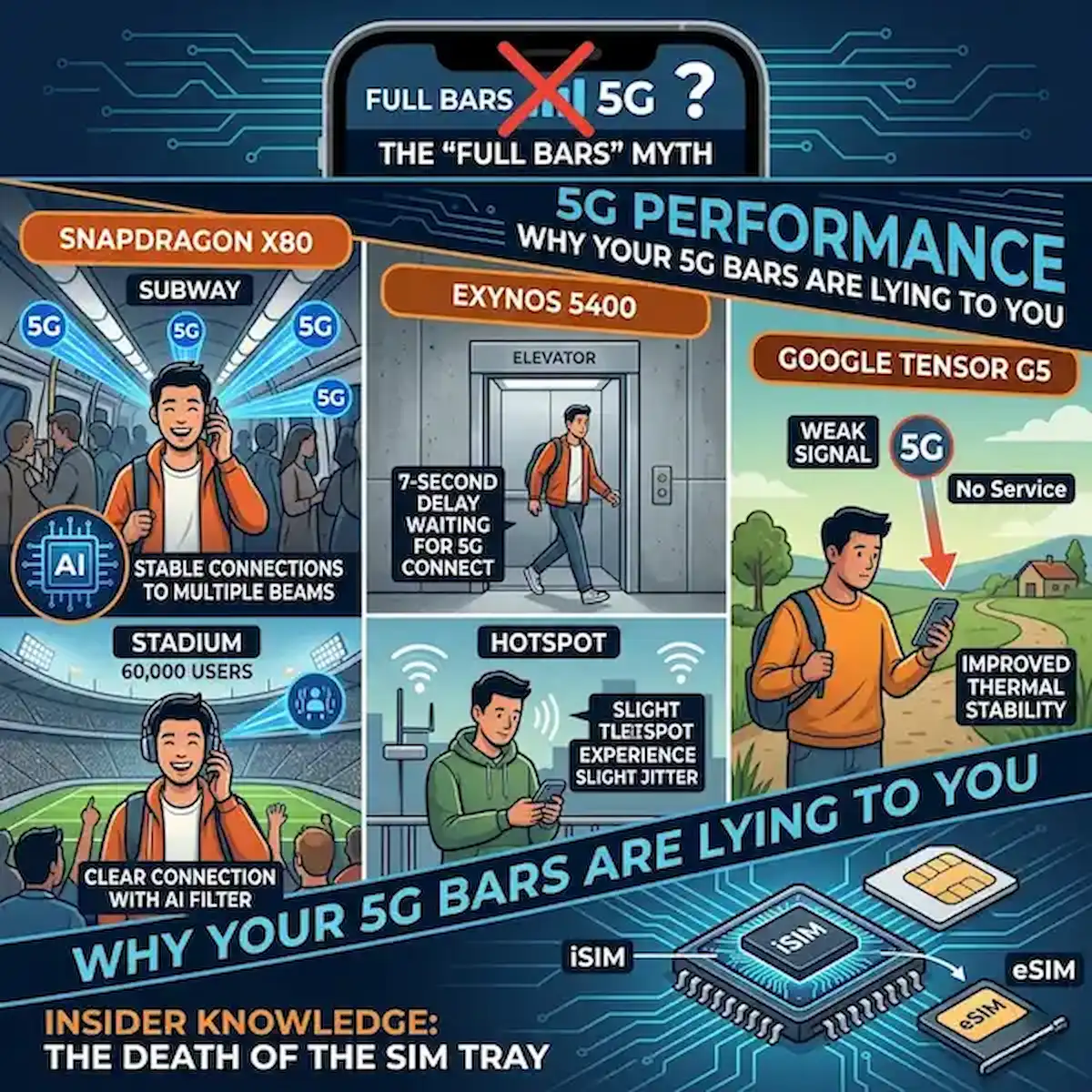
Qualcomm remains the undisputed king of the hill. The X80 isn’t just fast; it’s remarkably “sticky.” In my testing, while taking a subway through London, the X80 held onto a weak signal long after other phones had fallen back to sluggish 4G. When people talk about peak 5G performance, they are usually talking about this chip. The secret sauce is the Qualcomm 5G AI Suite, which uses machine learning to predict which cell tower will provide the most stable handoff.
- The Stadium Test: In a packed arena with 60,000 people, the X80 uses AI-driven beam management to cut through the noise. While my friends were staring at spinning loading icons, I was able to upload 4K video because the modem managed the 5G performance more efficiently than the tower could.
2. The Great Improver: Exynos 5400 (Samsung)
Found in: Samsung Galaxy S26 (Europe/Global).
For years, the word “Exynos” was a dirty word in the tech community. But in 2026, Samsung has finally closed the gap. The Exynos 5400 is efficient, and in standard outdoor use, you won’t notice a huge dip in 5G performance compared to a Snapdragon.
- The Elevator Test: Where it still stumbles slightly is reacquisition speed. When I stepped out of a concrete-heavy elevator, the Snapdragon phone regained connectivity in about two seconds. The Exynos took nearly seven. It’s a small delay, but it shows that 5G performance is about more than just download speeds.
3. The Efficiency Specialist: Google Tensor G5 (Google)
Found in: Pixel 10 and Pixel 10 Pro.
Google’s transition to TSMC-manufactured chips with the Tensor G5 has fixed the horrific overheating issues of the past. However, the modem—still based on Samsung’s architecture—is built for efficiency rather than raw “signal-grabbing” power. Your 5G performance here will be stable, but perhaps not as record-breaking in rural areas.
5G Performance Comparison Chart
| Feature | Snapdragon X80 | Exynos 5400 | Google Tensor G5 |
| Peak Download | 10 Gbps | 10 Gbps | 8.5 Gbps |
| Signal Retention | Elite | High | Moderate |
| Reacquisition Speed | Instant | Average | Slow |
| Thermal Stability | Excellent | Good | Much Improved |
The “Full Bars” Myth: Why Your Phone is Lying
I was recently at a music festival—full 5G bars on my screen. I tried to pull up a map to find my ride, and… nothing. The bar icon on your phone is a measurement of signal strength (RSRP), not signal quality or network capacity. According to the 3GPP standards, a phone can have a strong connection to a tower but zero actual data throughput if the “noise” is too high.
Your modem might see a strong signal, but if that signal is “noisy” because 10,000 other modems are screaming at the same tower, your 5G performance will tank. High-end modems use AI to filter that noise. Cheaper modems just get overwhelmed, even if they show you a “full” signal to make you feel better. This is the primary reason why 5G performance feels so inconsistent from block to block.
Insider Knowledge: The Death of the SIM Tray
If you’re planning on buying a phone in late 2026, say goodbye to that little metal paperclip. The iSIM (Integrated SIM) has finally arrived to finish what the eSIM started. Unlike an eSIM, which is a separate chip on the motherboard, the iSIM is baked directly into the modem itself.
Why this matters for your 5G performance:
- More Battery: Removing the physical tray and the eSIM chip saves space for larger batteries, which are needed to power the modem during heavy 5G performance tasks.
- Global Hopping: If you travel, iSIM is a dream. You can store dozens of local data plans on the modem and switch between them via software.
Real-World Use Cases
The Remote Worker
If you rely on your phone for a hotspot, your 5G performance is your lifeline. A Snapdragon-based device will maintain a more stable “ping” for Zoom calls than a lower-tier modem, which might jitter when switching between bands.
The Commuter
If your life involves trains and tunnels, the reacquisition speed of your modem is everything. You want a phone that optimizes 5G performance the microsecond you exit a tunnel, rather than staying stuck in a “searching” loop.
The International Traveler
With iSIM-enabled modems, you can land in Tokyo, tap a notification, and be on a local plan before you even clear immigration. This ensures your 5G performance stays high without the lag of roaming through your home carrier.
FAQ
Does a better modem improve battery life?
Yes. A struggling modem uses massive amounts of power trying to find a signal. Better hardware sustains 5G performance with less effort, saving you 10% battery on a heavy travel day.
Is 5G really better than 4G in 2026?
Only if your hardware supports 5G Standalone (SA). Older modems often “piggyback” on 4G via Non-Standalone (NSA) mode, which limits your 5G performance and increases latency.
Why does my phone get hot when I have a bad signal?
When the signal is weak, your modem cranks up its power to “shout” back at the cell tower. This creates heat and degrades 5G performance.
Additional Helpful Information
- Other ways to speed up your phone – How to Speed Up Your Phone: iPhone & Android
- Improve your WiFi connection – Improve Your WIFI Signal: Stronger, Faster Internet (iPhone/Android)