
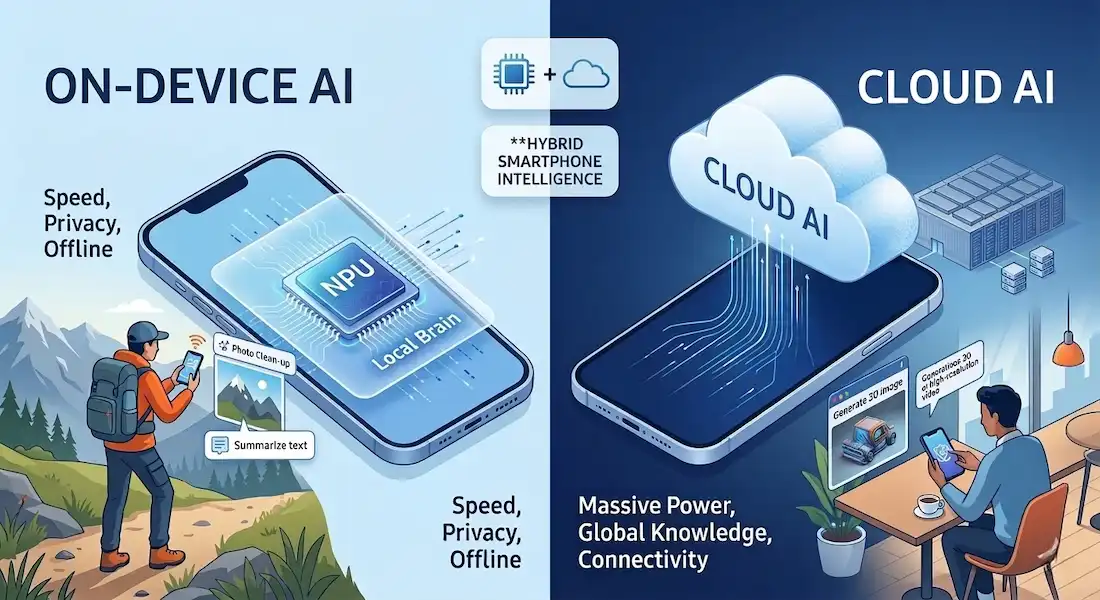
The Real Difference Between On-Device vs. Cloud AI
Key Takeaways
- Hybrid smartphone intelligence dynamically balances local NPU processing for immediate privacy and offline tasks with cloud servers for complex generative computing.
- On-device foundation models handle sensitive tasks like notification summaries, photo object removal, and real-time translation without sending personal data over the internet.
- Modern mobile silicon utilizes dedicated low-power efficiency cores that remain active continuously to manage background contextual awareness without draining the battery.
- Enterprise security management relies heavily on localized execution to prevent proprietary business data from entering public cloud LLM training sets.
- Offloading minor AI workloads locally reduces energy consumption in massive data centers while transferring part of the computational processing load directly to the user’s phone hardware.
What is hybrid smartphone intelligence and why does it matter?
Hybrid smartphone intelligence is an architectural framework that splits artificial intelligence tasks between a phone’s local silicon processor and remote cloud data centers based on the speed, power, and privacy required for each request.
When you sit in a basement coffee shop with zero cellular signal, your device relies entirely on its local chip to process requests. Two years ago, losing a network connection meant your phone’s smart features were completely offline. Today, local Neural Processing Units (NPUs) process tasks right under your thumb.
By routing smaller operations to internal hardware while reserving massive cloud servers for heavy generative workloads, mobile platforms ensure your assistant remains functional anywhere.
Why is on-device processing winning the privacy battle?
On-device AI keeps your personal information entirely contained inside your handset’s encrypted memory, preventing private documents and personal photos from ever reaching an external server.
When you use local foundation models on an iPhone or a Pixel running Google’s Gemini Nano, your sensitive files are analyzed locally.
- Zero Latency: According to technical performance reports from Qualcomm’s Snapdragon Platform Insights, local execution completes simple inference tasks up to ten times faster than waiting for a cloud server handshake.
- Privacy by Default: Sensitive medical records, private messages, and financial spreadsheets remain on your physical hardware rather than floating across third-party networks.
- Offline Reliability: Local processing functions seamlessly in airplane mode or across remote areas where cellular infrastructure is unavailable.
Having a localized system means your personal data stays behind biometric locks while maintaining peak responsiveness.
How does cloud AI handle heavy smartphone workloads?
Cloud AI provides access to massive data centers housing trillion-parameter models capable of performing deep analytical reasoning, large-scale image rendering, and high-definition video generation that mobile hardware cannot process alone.
Mobile processors like modern Snapdragon or Apple A-series chips face physical thermal and battery limitations. Running giant generative tasks locally would cause handset temperatures to spike and deplete the battery rapidly.
To solve this, systems route demanding queries to secure remote infrastructure, such as Apple’s Private Cloud Compute. According to research on emerging mobile infrastructure trends from ABI Research, remote servers remain essential for processing vast datasets that exceed local RAM capacities.
How do local silicon and cloud servers compare?
Local hardware excels at real-time privacy and offline speed, while cloud servers offer practically unlimited computational resources for complex creative projects.
| Feature | On-Device AI | Cloud AI |
| Response Speed | Near-instantaneous local execution | Variable based on 5G/Wi-Fi latency |
| Data Privacy | Maximum (Data never leaves physical chip) | Variable (Subject to cloud transmission) |
| Power Consumption | Medium (Utilizes local battery energy) | Low on phone (Server handles processing) |
| Model Capacity | Compact Small Language Models (SLMs) | Massive Large Language Models (LLMs) |
| Primary Use Cases | Auto-correct, image editing, text extraction | Video generation, multi-document synthesis |
Through hybrid smartphone intelligence, mobile operating systems automatically select the best path for every request without requiring manual configuration from the user.
What is happening inside the phone chip?
Modern mobile chipsets integrate specialized hardware blocks called NPUs that execute mathematical operations specifically tailored for machine learning models at extremely low power draw.
Engineers design modern system-on-chip architectures with dedicated low-power micro-cores that remain active around the clock. These tiny silicon blocks allow your handset to handle continuous context detection—like voice wake-word detection or crash detection—without activating the power-hungry primary CPU cores.
This dedicated hardware architecture is what makes modern hybrid smartphone intelligence efficient enough to run constantly without draining your battery by mid-afternoon.
How does the experience differ between iPhone and Android?
Apple emphasizes a strictly sandboxed, privacy-first pipeline, whereas Android implements a flexible, deeply integrated cloud-to-device infrastructure.
The iPhone Ecosystem
Apple runs most everyday assistant tasks directly on local silicon.
- Offline Photo Editing: Photo editing tools like object removal run entirely on local neural engines without an active internet connection.
- Cloud Integration: As detailed in Google’s official announcements on AI integration, external platforms step in only when users explicitly request broader world-knowledge queries that go beyond local system capabilities.
The Android Ecosystem
Google and Samsung utilize a fluid architecture that switches between local and cloud models based on task complexity.
- Contextual Features: Features like Circle to Search identify image elements locally before fetching relevant web indexes from remote servers.
- User Privacy Controls: Android settings allow users to restrict processing strictly to on-device hardware if they prefer to isolate their data from cloud networks.
Both ecosystems rely on hybrid smartphone intelligence to maintain high performance across daily usage scenarios.
What are the hidden battery costs of mobile processing?
Running complex models directly on a handset transfers the electrical energy cost from remote server farms directly to the user’s lithium-ion battery.
Every time your phone summarizes a document or removes an unwanted object from a photo locally, its internal silicon draws significant power. To support these workloads, device makers continue to expand battery capacities alongside 3nm architecture optimizations.
While offloading tasks to internal hardware keeps data private, balancing local heat generation against cloud offloading remains a central design challenge for hybrid smartphone intelligence.
Why are enterprises adopting local mobile processing?
Corporate IT departments prefer localized mobile processing because it prevents sensitive business communications and proprietary data from being logged by public cloud servers.
In previous years, many organizations restricted employees from using cloud-based generative tools on enterprise devices due to data leak risks. Today, localized security boundaries allow corporate networks to deploy secure assistants directly on employee phones.
According to insights published in the Deloitte State of AI Enterprise Report, maintaining sovereign control over internal data represents a primary requirement for enterprise technology deployments. Localized execution keeps sensitive corporate information secured safely behind the user’s biometric lock screen.
What happens to smart phone features during network outages?
Smartphones running local small language models retain core functionality—such as setting alarms, searching personal notes, and summarizing local files—even when network connectivity is lost completely.
In earlier smartphone generations, loss of internet access meant built-in voice assistants failed instantly. Today’s compressed SLMs run independent of network status.
System architectures built on hybrid smartphone intelligence ensure that vital local utilities remain responsive offline while queuing heavier online requests until internet access is restored.
Do you need a new phone for modern features?
Accessing advanced local processing capabilities requires recent hardware equipped with dedicated neural processing cores and expanded RAM configurations.
Older mobile processors lack the specialized matrix-multiplication hardware needed to run local foundation models efficiently. Running these tasks on legacy hardware results in severe thermal throttling and poor battery life.
If you value total data privacy and need an assistant that functions reliably in low-connectivity environments, upgrading to hardware optimized for hybrid smartphone intelligence delivers a faster, more secure mobile experience.
Comparing On-Device AI vs. Cloud AI
Choosing between local processing and cloud-based execution involves balancing privacy, speed, hardware demands, and capability. Below is a comprehensive breakdown highlighting the core pros and cons of each approach.
On-Device (On-Phone) AI:
On-device AI executes models directly using the phone’s internal hardware, specifically the Neural Processing Unit (NPU), CPU, and GPU.
Pros
- Maximum Privacy & Security: Personal data, documents, and photos never leave your device, keeping sensitive information behind physical biometric protection.
- Zero Latency: Eliminates network delays (ping/handshake), delivering near-instant responses for everyday tasks like photo editing, voice typing, and auto-correct.
- Full Offline Functionality: Works anywhere regardless of cellular signal, Wi-Fi availability, or airplane mode status.
- No Subscription or API Costs: Local operations do not incur ongoing cloud server processing fees for hardware manufacturers or end users.
Cons
- Hardware & RAM Constraints: Limited by the physical memory and compute capability of your phone, restricting execution to smaller models (SLMs).
- Battery & Thermal Impact: Heavy local processing generates heat and draws directly from the phone’s battery reserve.
- Requires Newer Hardware: Older smartphones without dedicated NPUs cannot run local foundation models efficiently.
Cloud AI:
Cloud AI routes complex queries over the internet to remote data centers equipped with massive server clusters.
Pros
- Unmatched Model Power: Accesses trillion-parameter models capable of deep analytical reasoning, long-form creative writing, and high-definition video generation.
- Saves Local Phone Battery: Offloads heavy mathematical calculations to external server infrastructure, preserving phone battery life.
- Hardware Agnostic: Can deliver advanced AI features to older or lower-cost smartphones, provided there is an active internet connection.
- Continuous Server Updates: Models update instantly on the cloud without requiring large system OS downloads on your device.
Cons
- Internet Dependence: Completely non-functional in dead zones, low-signal areas, or while in airplane mode.
- Latency Delays: Introduces response lag caused by data traveling over 5G/Wi-Fi to remote servers and back.
- Data Privacy Risks: Involves sending personal data across external networks and processing it on third-party cloud infrastructure.
Summary Comparison Matrix
| Feature / Metric | On-Device AI | Cloud AI |
| Primary Advantage | Complete Privacy & Zero Latency | Massive Computational Power |
| Primary Limitation | Model Size & Hardware Limits | Internet Dependency & Latency |
| Data Location | Encrypted Local Memory | Remote Server Data Centers |
| Offline Capability | 100% Functional | Non-Functional |
| Best Used For | Real-time edits, text summaries, UI actions | 4K video gen, complex research, heavy LLMs |
| Hardware Requirement | Recent flagship chipsets (NPU) | Any device with network connectivity |
Frequently Asked Questions
Does local processing drain my battery faster than cloud processing?
Processing data locally uses more phone battery power than simply sending a text query to an external cloud server. However, modern chipsets feature dedicated neural cores designed to run these tasks efficiently, minimizing the impact during normal daily use.
Can legacy smartphones run local foundation models through software updates?
Most advanced local features require dedicated neural processing hardware and higher memory capacity. Legacy handsets without these hardware components must rely on cloud servers to perform complex processing tasks.
Is cloud processing inherently insecure compared to local processing?
Cloud processing relies on encrypted transmission channels and secure server environments, but it inherently introduces additional data touchpoints. Local processing keeps data contained strictly within your physical device, offering the highest level of isolation.
How does hybrid smartphone intelligence select where to process a request?
The operating system evaluates the complexity of the request, network availability, battery level, and user privacy preferences to decide whether a task should run locally or be forwarded to a cloud server.
Will future software updates expand what my phone can do offline?
As machine learning models are continually compressed and optimized, tasks that currently require cloud computing power will gradually become small enough to run locally on your phone’s existing hardware.
Additional Helpful Information
- Read about hybrid wearable integration – Mastering Hybrid Wearable Integration for iPhone and Android
- Compare the AI processing latency – Apple Intelligence vs. Gemini Nano: On-Device AI Processing Latency Compared